Active Investors, AI-Native Teams, and the New Fundraising Math | The Capital Splash
June 2026


Welcome back to The Capital Splash, where we break down the signals founders should actually pay attention to across venture and fundraising🚀
📣 Top news
📈Defense tech, AI, and fundraising take center stage at StrictlyVC Los Angeles on June 18
TechCrunch’s upcoming StrictlyVC Los Angeles event is putting defense tech, AI, and fundraising front and center, reflecting where investor attention is increasingly moving in 2026.
Why care?
The sectors dominating conversations at top VC events are often the same sectors attracting capital. For founders, paying attention to where investors are spending time can reveal where market conviction is building fastest.
❌Active Startup Investors Didn’t Hold Back In May
New Crunchbase data highlights which investors have been the most active in recent months, with firms like a16z, General Catalyst, and Y Combinator continuing to lead early-stage activity despite a more selective venture market.
Why care?
In today’s environment, targeting active investors matters more than ever. Founders who focus on firms that are actually deploying capital, instead of building broad “spray-and-pray” lists, are far more likely to build momentum during a raise.
🎧 What we are listening to
🎙️Anthropic Files to Go Public, Token Budgeting Panic Hits Corporate America, Cognition Raises $1BN at $26BN Valuation | The Twenty
Minute VC
Jason Lemkin and Rory O’Driscoll unpack one of the biggest AI market shifts yet, from Anthropic’s IPO plans and Cognition’s $26B valuation to why investors are resetting expectations around SaaS, software pricing, and engineering teams. The episode explores how agentic products are reshaping the market, why “token budgeting” is becoming a real corporate concern, and what happens when companies start choosing AI systems over headcount.
🎧 Listen on The Twenty Minute VC
🎙️What It Means to Be Raised by AI | Masters of Scale
AI safety leaders from MIT Media Lab explore how growing up alongside AI could reshape work, relationships, education, and society itself. The conversation looks at the future of AI guardrails, regulation, and what human flourishing could look like in a world where AI may eventually surpass human intelligence.
🪄Bonus: LP Edge #2: The Great Concentration: Why 5 Funds Captured Half of Venture Capital in One Quarter | Hot Off the Cap Table (HOTC)
Charlotte breaks down Q1 2026’s record $80B+ fundraising quarter, and the reality beneath it: a small group of mega-funds captured a disproportionate share of the capital. The episode explores what Kleiner Perkins’ $3.5B raise signals to LPs, why the secondary market is booming, and how capital concentration is reshaping venture.
🎧 Listen on Hot Off the Cap Table
🗓️Upcoming Events
🎤 StrictlyVC Los Angeles (June 18)
Why to attend?
For Founders: Hear directly from top investors and operators about where capital is actually moving in AI, defense tech, and infrastructure, while building relationships with the people shaping the next wave of venture-backed companies.
For VCs: Stay close to emerging themes attracting investor attention in 2026 and connect with founders building in sectors where conviction, and capital deployment, is accelerating.
🚀 Tech Weekend (June 18–19)
Why to attend?
For Founders: Get direct access to investors, fundraising conversations, office hours, and pitch opportunities in a highly concentrated founder-and-VC environment built around real networking and deal flow.
For VCs: Meet a dense group of pre-seed to Series A founders actively fundraising, while building relationships with emerging startups before broader market visibility catches up.
❌Most VCs are building AI workflows the wrong way
Right now, many venture firms are trying to stitch together their own AI operating systems.
Claude Projects filled with firm data. Custom GPTs trained on founder decks. Personal AI agents connected to inboxes, calendars, and deal flow pipelines. Sensitive LP information and investment context spread across tools that were never designed for venture workflows or security.
The problem isn’t the models. It’s the system around them.
Most firms don’t need another standalone AI tool. They need structured memory, persistent context, workflow integration, and infrastructure that actually fits how venture firms operate.
That’s why we built Capwave for VCs.
An AI chief of staff designed specifically for venture firms, with the context layer, security, and operational workflows that modern investing actually requires.
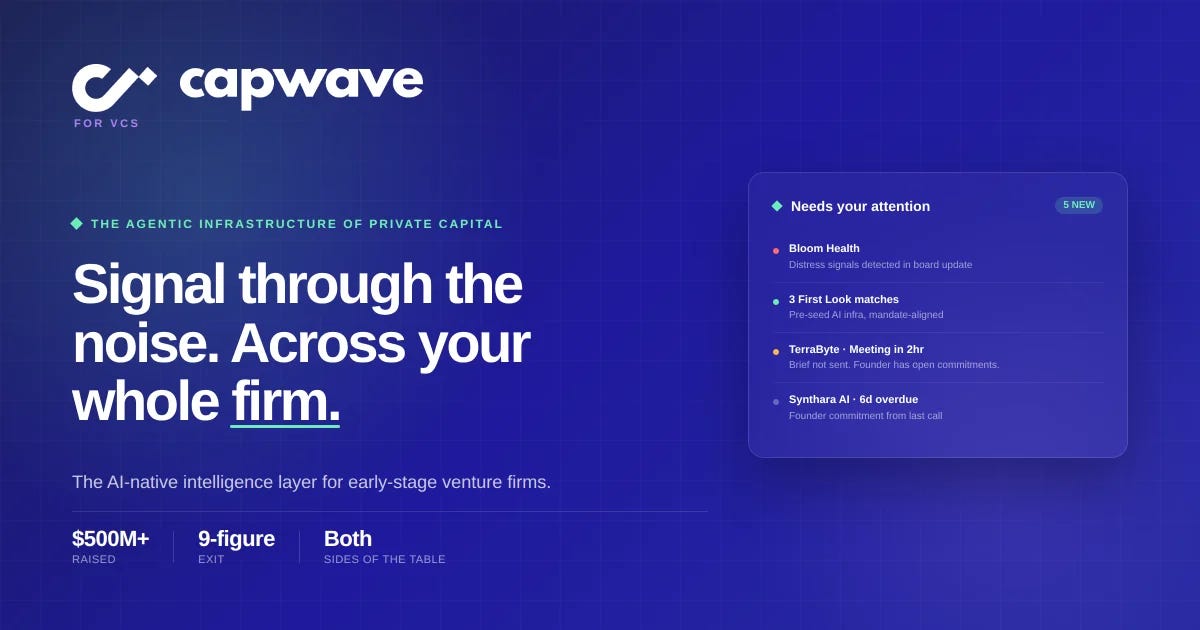
MeetingIQ prepares briefs before every founder call and captures commitments after.
InboxIQ tracks founder conversations across the pipeline, flags responsiveness, and surfaces discrepancies between what’s said in meetings and what’s written in decks.
Built for emerging and micro funds first.
You focus on picking winners. We’ll handle the system around it.

How to price an AI product in 2026: the slide 7 framework for founders
AI startups are discovering that traditional SaaS pricing models don’t cleanly translate to AI products. As token costs fluctuate and AI becomes embedded into workflows, founders are being forced to rethink everything from per-seat pricing to usage-based models and outcome-driven pricing.
This guide breaks down the pricing strategies AI-native startups are using in 2026, what investors are paying attention to, and how founders can avoid building products with strong growth but weak margins.
Why this matters
Pricing is no longer just a revenue decision, it’s part of the product strategy itself. In an AI market where infrastructure costs and customer expectations shift quickly, pricing can directly impact scalability, retention, and investor confidence.
How Capwave helps
That’s where Capwave comes in.
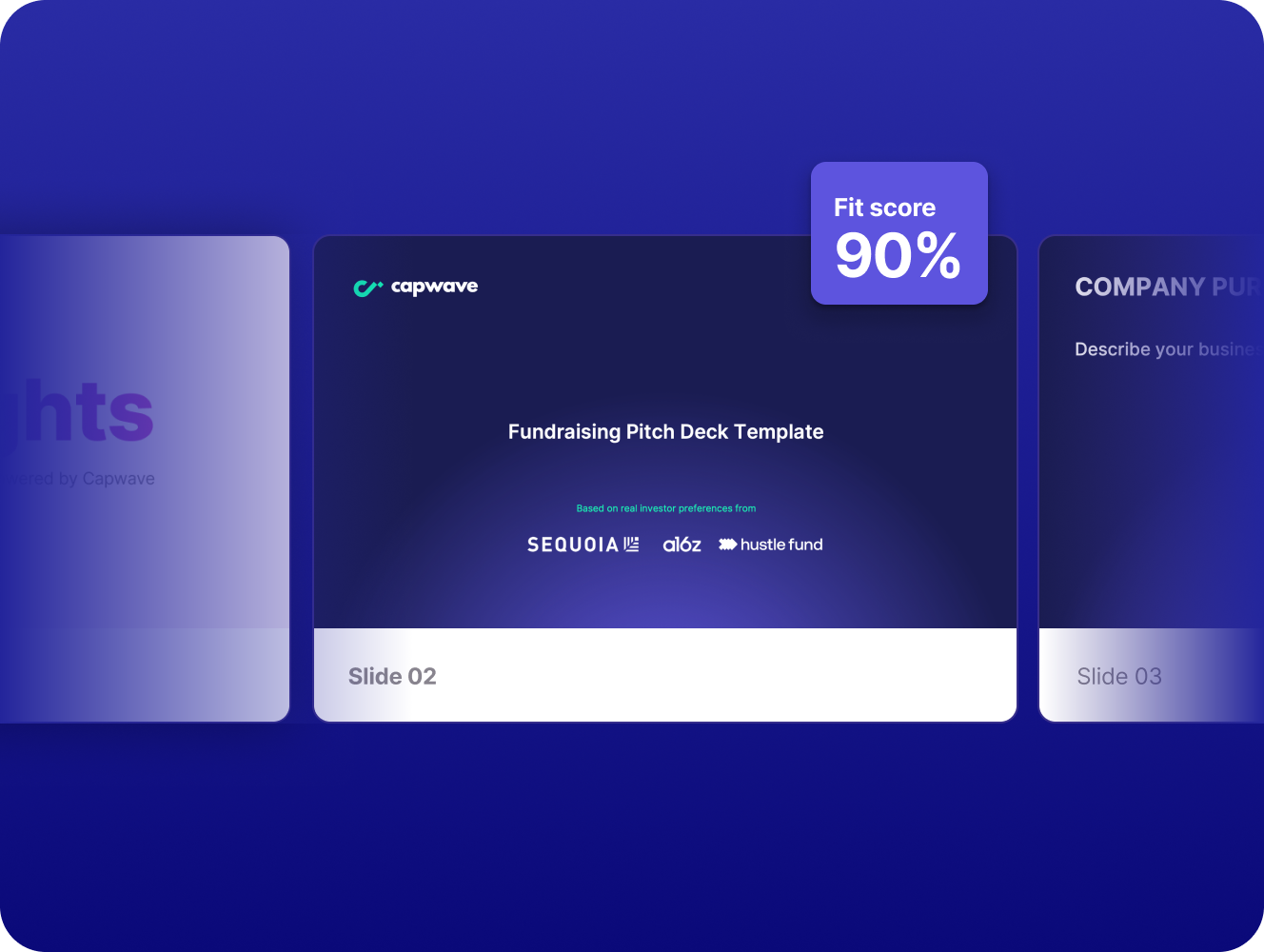
With PitchIQ, founders can pressure-test how they position their AI product and communicate value to investors. With InvestorIQ, they can identify investors actively backing AI-native companies and infrastructure-driven businesses.
Instead of guessing how to frame the business, founders can build a narrative that aligns with how investors evaluate AI companies today.

Post-money SAFE stacking in 2026, the dilution math 83% of founders get wrong
Multiple SAFEs can quietly create far more dilution than founders expect. This guide breaks down how SAFE stacking impacts ownership, post-money calculations, and future fundraising dynamics.
The 3 team questions VCs now ask on first calls in 2026
In 2026, investors are evaluating teams differently, especially in AI-native startups. This post explores the key questions VCs now ask early to assess adaptability, execution speed, and founder leverage.
If this edition was useful:
🔁 Restack it so more founders see it
📩 Share it with a founder who’s raising or planning to
⭐ Save it for when you need to get back
And if you’re raising or planning to raise, Capwave helps founders prepare before the conversations start.
Start sharping your raise on Capwave👇🏻